
Free and open source · Apache 2.0

Every token leaves a trail.

Toktail is a free app that counts every token your local AI models process, and shows what the same work would cost from cloud AI. If the AI bubble bursts, you'll already know your numbers.

Pip's mood
Click Pip, or wiggle your cursor near it.
Pip the Token Fox, sitting with its glowing chart tail

Download

Get Toktail. It's free.

No account, no subscription, nothing to upgrade to. Version 0.4.0, open source under Apache 2.0.

Download for macOSApple silicon and Intel

There's no packaged release yet, so every button downloads the source code. On a Mac, make demo builds it and runs it with sample data.

Snapshot · October 2026

One rig rendered, in 37.73 hours,

472,000,000 tokens rendered in 37.73 hours

472 million tokens from DeepSeek V4, a 155 GB model, running on my own hardware.

Throughput3,475 tok/sin and out, run average
Electricity$1.99for the whole run
Same tokens on Opus 5.5$1,904at list price
$ tail -f tokens-2026-10.csvsample rows
timestamp,model,status,input_tokens,output_tokens,ttft_ms,output_tokens_per_sec

One row per request, in a plain CSV on your own disk. Open it in Excel or Numbers.

What 472M tokens cost

Same tokens. Four price tags.

Toktail priced this run at each provider's list price. The grades are mine: how much of the work I'd keep, on the same scale I used to grade students when I taught night classes in Boston.

Cost of 472M tokens over 37.73 hours
$52.57

a day back, for the same D+ work. $66.95 a work day through the API, $14.38 on my own machine with the hardware paid for.

4.7×

less per day for the same grade of work, hardware included. On electricity alone it's 159× less.

$403.71

a work day for Opus 5.5 at this pace. Better work, at 28 times what my machine costs.

Cloud prices are list prices from Toktail's built-in pricing table, collected October 11, 2026, without caching discounts. A work day is 8 hours at this run's pace of 12.5 million tokens an hour. Hardware is the machine's price spread over its expected life, as entered on Toktail's Savings page. Electricity is what the machine drew during the run. Grades are my own judgment.

Price your own trail

Your tokens. Every price tag.

Drop a Toktail CSV here and see what your own requests would have cost at 17 cloud providers, priced with the same table Toktail ships. It all happens in your browser. Nothing is uploaded.

Toktail's monthly CSVs, or any CSV with input and output token columns. Several files at once are fine.

How I use AI

Faster, but harder.

I can get to an A+ on my own. AI gets me there faster, and it makes the work harder. Which kind of harder is up to you.

A- / B+

The one-shot A-

A frontier model hands you polished work in one pass. To get it to an A+, you rework code you didn't write and don't fully know.

D+

The junior's first draft

A local model hands you a scaffold, the kind a fresh master's grad turns in when they put in the minimum. It's rough, and you steer it from the first line.

Some engineers don't want a tool that does the job for them. They want a junior they can teach, train, and send off like an arrow.
from: Andrei, who built Toktail re: why this exists

Why I built Toktail

I've been a software engineer for 17 years. I use AI the way I use a compiler: as a tool for my job. I won't pay for a tool that costs me my livelihood, and I don't need one.

Recently an engineering manager I know told me what his team's coding agents cost each day. It was more than any engineer on his team earns in a day.

His words: "This is unsustainable."

I think the AI bubble will burst. I don't know when. When it does, teams will need to know what their AI work actually costs, and what the same work costs on hardware they already own. Toktail shows you both, today, for free.

Andrei
Senior Computer Engineer, B.S. · 17 years in the field · @andreimerlescu
What it does

Pip counts. You decide.

Counts every token

Toktail sits between your apps and LM Studio. Every API request is logged: tokens in and out, time to first token, and tokens per second.

Prices it like the cloud would

Each request is priced against 17 cloud models at list price, on its own date and at its own size, next to the electricity your machine used.

Shows when your hardware pays off

Enter what your machines cost. The Savings page spreads that over each machine's life and shows monthly and yearly savings.

Keeps your data in plain files

One CSV per month that opens in Excel or Numbers. Prompts are kept as fingerprints unless you turn on encrypted capture.

Watches every machine

Track up to 17 hosts together or one at a time, by model or by host. Back up to your own S3 bucket if you want a copy.

Comes with Pip

Pip lives in your menu bar. Ask Pip about your trail and it answers with exact numbers from your CSV, using your own model.

See it

The portal, as it is.

Real screenshots from Toktail 0.4, running the demo data that ships with it.

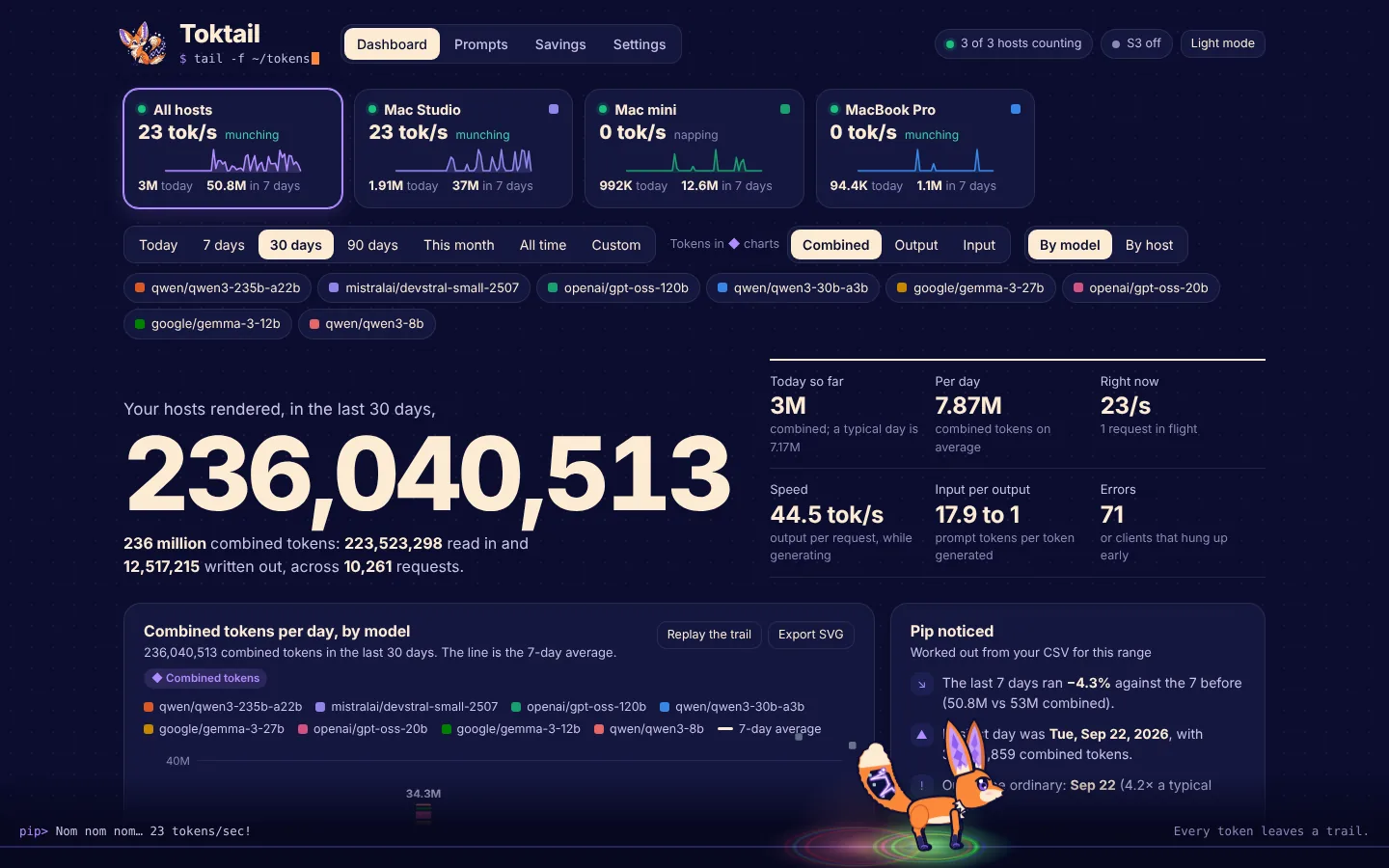
The Toktail dashboard in dark mode: tokens per second for All hosts, Mac Studio, Mac mini and MacBook Pro, a 236,040,513 token total for the last 30 days, and a tokens-per-day chart by model
The dashboard: every host's tokens per second, the 30-day total (236 million in the demo), tokens per day by model, and Pip on the trail at the bottom.

How it works

Three steps. Nothing else changes.

  1. Install Toktail

    Run make install. Pip shows up in your menu bar and the portal opens.

  2. Move LM Studio's server

    make lmstudio moves it to port 1235. Toktail takes 1234 and forwards every request.

  3. Keep working

    Your agents talk to the same address. Every request now lands in your CSV and on the dashboard.

Questions

Good questions.

Is it really free?

Yes. Toktail is open source under the Apache 2.0 license. There's no account, no subscription and nothing to upgrade to.

Does the app send anything off my computer?

No. Your CSV, settings and prompt fingerprints stay on your machine. The one exception is S3 backup, which is off until you turn it on and goes to your own bucket.

What does this website record?

Only downloads. When you click a download button we record the time, your IP address, your operating system and CPU type, your browser's user agent and your country, so we can count downloads and see which platforms to support. IP addresses and user agents are deleted after 90 days. There are no cookies, ads or trackers. The privacy policy has the details.

What does it work with?

Any app or agent that talks to LM Studio's API, on the same machine or across your network. Chats typed into LM Studio's own window don't go through the API, so they aren't counted.

Where do the cloud prices come from?

Toktail ships a pricing table of list prices for 17 models, without caching discounts. When prices change, you can drop in your own pricing.json.

Why grade the local model a D+?

Because that's the work I got: a fast first draft that needs a senior engineer. Toktail doesn't make a model smarter. It shows what each draft costs, so you can decide where each kind of work belongs.

Ready to see your own numbers?

Download Toktail